Can You Get Roundworms From Beef
The following video explains the different types of internal parasites that touch beef cattle in Canada (xvi:58), the economic impact they can have (27:39), drug resistant parasites (36:54), and control strategies (40:06).
Internal roundworms
A mutual myth is that it is besides cold in Canada for roundworm parasites to be a problem, but that is non the case.
Unlike external parasites such every bit lice and flies, which are frequently clearly visible, internal roundworm parasites are less obvious, notwithstanding they are extremely mutual. Cattle that are afflicted past roundworms can have depressed weight gains, poor feed efficiency, diarrhea in calves, and reduced milk production and reproductive inefficiency in cows. Parasite species too vary past region.

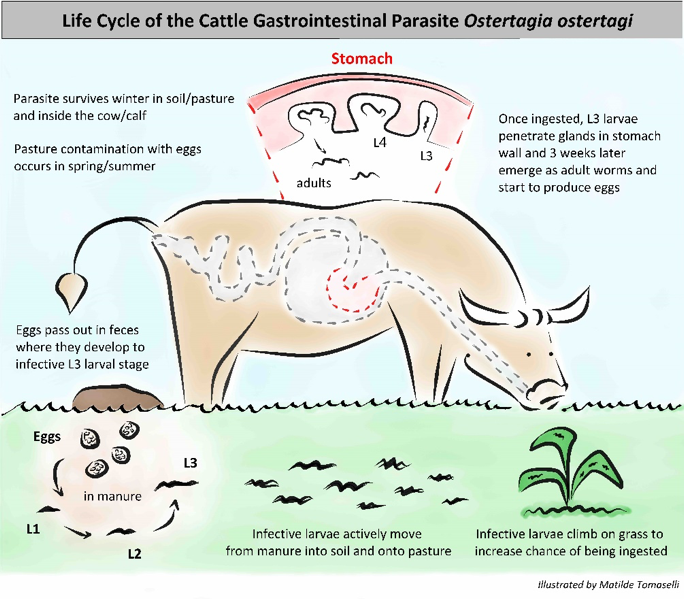
The lifecycle of other internal roundworm parasites such asCooperia oncophora, Cooperia puntata, Nematodirus helvetiatianus,are very similar. The key to parasite transmission and control for these roundworm species is pasture contamination. Adult roundworms living in the gastro-abdominal tract produce eggs which laissez passer out in the carrion and then develop to infective L3 larvae in the fecal pat. This can occur in as little every bit 7 days under optimal conditions but tin can take several weeks in cooler weather. The L3s then migrate into the soil and onto the grass where they are ingested by cattle during grazing. Transmission only occurs on pasture considering L3s do not survive in indoor or feedlot pen environments. Although the evolution from egg to L3 only occurs in the jump, summer, and early autumn, infective L3 larvae tin survive over the winter in the soil and be a source of infection to cattle grazing the following spring. Parasites likewise survive over the winter within the animal host as developed worms and inhibited larvae. The pasture contamination builds upwards over the grazing season to maximum levels in the tardily summer and early on autumn. Parasite egg counts in cattle in Canada tend to be in the range of 1- 50 eggs per gram (epg) of feces but in situations of heavy pasture contamination counts up to 200-300 epg in a few private animals can occur. If y'all consider a typical beefiness moo-cow might produce 30kg of feces each twenty-four hour period, a single cow with an egg count of ten epg would shed ~300,000 eggs onto the pasture each mean solar day!
The infective L3 larvae tin survive the winter on pasture to varying degrees, even in Canada, and adult worms and inhibited larvae can survive during the winter inside the host. The relative importance and success of roundworm "overwintering" strategies volition vary depending on the temperature, moisture and snowfall comprehend in a particular yr. During the bound, summer and autumn, the numbers of infective larvae build upwardly on pastures at levels that also depend on the temperature and wet during the grazing flavor. Warm and wet summers, and regions building up more pasture contagion, can lead to higher worm burdens in beefiness cattle.
Economical impact of internal roundworms
The largest academic assessment ofproduction impacts of internal roundworm parasites occurred in North America in 2007. The study evaluated the economic affect of parasite control, growth promoter implants, sub-therapeutic antibiotics, ionophores and b-agonists. The written report establish that, of these practices, deworming had the biggest positive touch on in cow-dogie (23% for weaning rates), stockers ($20.77 per head in breakeven prices) and the second highest do good after growth promoter implants at the feedlot (5.six% improvement in average daily gain and three.ix% reduction in the feed-to-gain ratio).
Studies from the northern United States showed that production gains occurred when parasite burdens were eliminated using a long-acting anthelmintic known as eprinomectin, a slow-release injectable formulation (Kunkle 2013). In the US report, untreated cattle had fecal egg counts ranging from 2-84 eggs/gram. Once treated, cattle had effectively zero egg counts. This resulted in production gains averaging between 0.16-.54lb/mean solar day over 120 days of grazing, providing calves an additional 14-65 lb overall proceeds. Similar egg counts within this range are unremarkably seen in Canadian beef cattle with the major species present being roundworm species likeOsteragia ostertagi,Cooperia oncophora andNematodirus helvetianus. This suggests that good roundworm control should produce pregnant product gains in Canadian beefiness cattle equally well. This is supported by a recent study showing similar gains for stocker cattle in Western Canada (Rademacher et al., 2018).
Effectiveness of parasite control

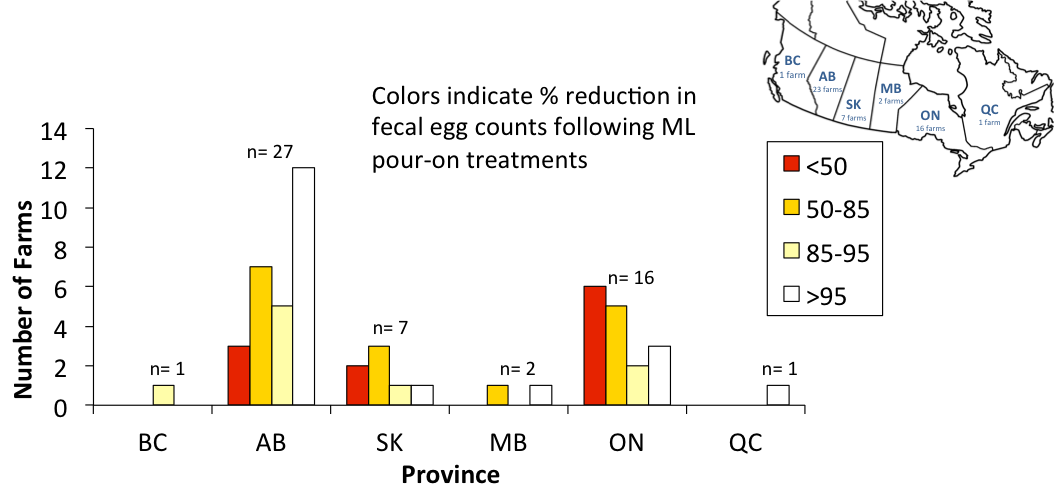
The chart shows the pct reduction in roundworm egg counts following an ivermectin or doramectin cascade-on treatment in ~50 beef herds beyond Canada. Fecal samples were taken from 20 calves in the herd before pour-on treatment and 2 weeks after pour-on treatment and fecal egg counts were conducted. The unlike coloured bars signal the numbers of herds in each of the following categories; less than 50%, 50-85%, 85-95% and greater than 95% reduction in fecal egg counts post-obit treatment. From this report, we know that internal roundworm parasites are not well controlled in Canadian beef cattle and the bulk of parasite burdens detected were plenty to likely cause product losses.
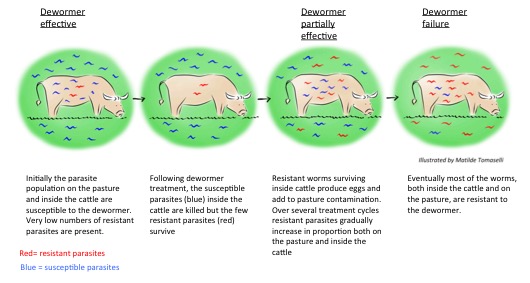
Drug-resistant parasites are an inevitable event of using dewormer. The more nosotros utilize these products, the more than resistance develops over time. Consequently, it is of import that dewormers are used in a way that maximize benefits but prevent overuse in order to maintain their efficacy in the longer term.
Prevention and control measures
A skillful internal roundworm parasite control program should maximize production gains, minimize affliction gamble but avoid haphazard and unnecessary dewormer use. The aim is to use the right product at the correct time on the animals that need it almost. The issues and practicalities of roundworm parasite command differs significantly between cow-calf, stocker and feedlot cattle likewise every bit with the grazing and management strategies of each individual herd.
Recommended practices are outlined beneath however producers should consult with their veterinarians to develop a parasite control program appropriate for their specific herd and environment.
Grazing management
Avoid overstocking and overgrazing.Heavily stocked pastures leads to increased pasture contamination with infective parasite larvae. Overgrazing increases the number of parasite larvae ingested since cattle graze closer to fecal pats and closer to basis where the numbers of parasite larvae are highest.
When possible, avoid grazing the same pastures in the fall of one twelvemonth and the spring of the side by side.Infective parasitelarvae from eggs deposited in manure in fall may survive the winter on the pasture and be a source of pasture contagion for cows and calves grazing in the spring.
When possible, harrow pastures only when it's hot and dry.Harrowing under other conditions will increase the potential exposure of cattle as infective larvae are scattered from fecal pats beyond the area.
Consider parasite control when planning rotational grazing strategies.For example, ifa twice-over or rotational grazing system is implemented, be enlightened that pastures previously grazed by yearling or stocker cattle may be heavily contaminated with infective parasite larvae and so be a risk to younger cattle.
Monitor parasite burdens
Conduct fecal egg counts on your herd to assess internal roundworm parasite loads and determine which parasites yous need to target.Consult your veterinarian, who can advise on sampling strategy. Collect fresh manure samples and submit to your veterinary who can perform fecal egg counts and interpret your results. Typically, fecal samples from 20 cows in the spring and from 20 calves in the fall will provide useful data on parasite burdens in the herd and the effectiveness of current control programs. Fecal egg counts are only an indirect measure of worm burdens therefore results need to be interpreted in the context of your grazing direction, product practices, and parasite control regimes.
Apply dewormers finer and responsibly

The five "C'due south" of Parasite Control
- Use the right product
- Apply to correct class of brute
- Apply at the correct fourth dimension
- Use the right dose
- Check for efficacy
Administer the dewormer at the correct fourth dimension.Dewormers should be used strategically to minimize pasture contagion and prevent the build-up of roundworms in the cattle during the grazing season. Treatments are often given when it is convenient – when cattle are being candy - rather than at the best time for control. Consequently, in many herds, roundworm control depends on pour-on treatments applied in the fall, partly because of the demand to also control external parasites. However, spring treatments can sometimes provide added benefits leading to lower roundworm burdens in the fall.Producers should consult their veterinarians to program a strategic worm command program that balances best do with the applied realities of herd direction.
Administrate the dewormer properly.Weigh cattle to ensure you administrate the right dose for the particular class of cattle you are treating. Underdosing is ineffective and leads to resistant parasites.Use the proper route of commitment for the specific product (oral, injectable, fed, topical). Follow veterinarian advice and label instructions for administration, storage and withdrawal times prior to slaughter. Adhere to recommended practices in Canada's Verified Beef Product+ on-farm food safety program. Properly dispose of expired product, empty containers and used needles.
Bank check the effectiveness of dewormer treatments.Exercise not assume a dewormer treatment has been effective. It is increasingly important to cheque the effectiveness of treatments to prevent parasite resistance. This can be done by taking fresh fecal samples and performing fecal egg counts approximately two weeks after deworming. Collecting and analysing 20 samples from cows and 20 samples from calves will provide a skillful judge of the treatment efficacy for the grouping.
Biosecurity
New cattle introduced onto your farm are a source of parasites that will contaminate your pastures. Treating such cattle with a combination of dewormers from the two major drug classes (eg. Ivermectin plus fenbendazole) will minimize the risk of bringing resistant parasites into your subcontract. Consult your veterinarian to discuss your parasite biosecurity program.
Progressive ideas

Utilise a combination of two dewormers. Dosing cattle with 2 dewormers of unlike classes at the same time both maximizes the effectiveness of handling and slows the development of resistance. It is important not to mix products before dosing but to administer each sequentially, using the correct administration route and following the label instructions. Consult your veterinarian surgeon to hash out using dewormer combinations as part of your herd health and parasite command programs.
Common parasite control products bachelor in Canada
| Common Parasite Control Products | Parasites Controlled | Mode of Administration | Examples of Brand Name of Products Registered for Utilize in Canada |
| Fenbendazole1 | Internal Roundworms | Feed, Mineral, pellets Oral Drench | Safeguard Safeguard, Pancur |
| Albendazole1 | Internal roundworms, tape worms, lung worms | Oral drench | Valbazen |
| Ivermectin2 | Internal roundworms, heart worms, lungworms, cattle grubs, lice and mites | Topical pour-on Injectable | Bimectin, Ivomec, Noromectin |
| Moxidectin2 | Internal roundworms, lungworms, cattle grubs, lice and mites | Topical pour-on | Cydectin |
| Doramectin2 | Internal roundworms, lungworms, middle worms, cattle grubs, lice and mites | Topical cascade-on Injectable | Dectomax |
| Eprinomectin2 | Internal round worms, lungworms, grubs and mites | Injectable, sub-cutaneaous irksome-release formulation | LongRange |
| Cyfluthrin | Horn flies, lice | Topical cascade-on | CyLence |
| Permethrin | Horn flies, lice, Rocky Mount forest ticks | Topical pour-on | Boss |
| Diazinon | Horn flies, face flies | Ear-tag | Eliminator, Protector, Optimizer |
| Monensin | Internal Coccidia | Feed | Rumensin, Coban, Monensin |
| Lasalocid | Internal Coccidia | Feed | Bovatec, Avatec, |
| Decoquinate | Internal Coccidia | Feed | Deccox, |
| Toltrazuril | Internal Coccidia | Oral drench | Baycox |
*Every try has been made to ensure the accuracy of the information higher up. Nevertheless, information technology remains the responsibility of the readers to familiarize themselves with the product information contained on the Canada product label or package insert. Ensure characterization directions and veterinarian instructions are followed when using whatever veterinary product.
The first five drugs on the list are dewormers with activity against internal roundworms.
ane Fenbendazole and albendazole belong to same drug class (Benzimidazoles).
2 Ivermectin, Doramectin, Moxidecitn vest to same drug grade (Macrocyclic lactones).
Source: https://www.beefresearch.ca/research-topic.cfm/internal-parasites-50
0 Response to "Can You Get Roundworms From Beef"
Post a Comment